
From Refugee to “Pima Hero”
Zamir ahmad Azizi Builds a Future in Tucson and Lifts Others Along the Way
By Anne T. Denogean for Marketing, Communications and Strategic Outreach
When Zamir ahmad Azizi left Afghanistan as a refugee in 2021 August, he didn’t know where he would land — literally.
After the fall of the U.S.-backed Afghan government in August 2021 and replacement by the Taliban, Zamir, along with his his mother and sister, were relocated to the United States to a military camp Fort Dix, New Jersey. They had no idea which city would become their new home until three or four months before they got on a plane to Tucson in January 2022. His brother had been sent here earlier and Tucson was identified as a growing community where refugee families could rebuild and thrive.
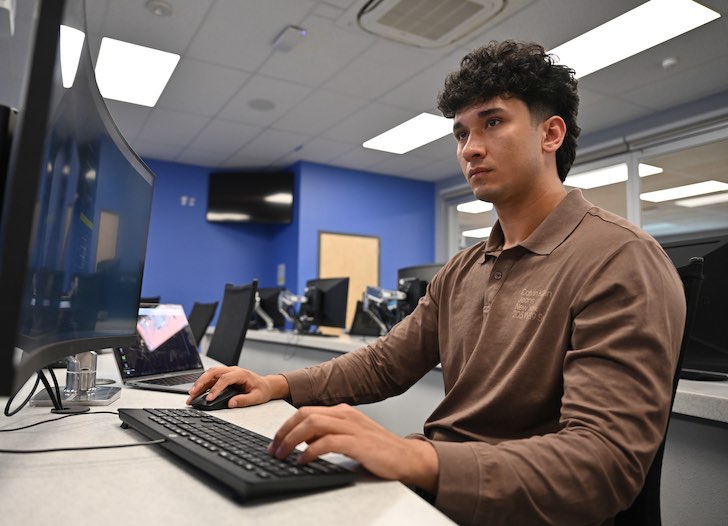
Today, Zamir is just one class away from earning his associate degree in cybersecurity at Pima Community College. He also is in his first semester at the University of Arizona, studying cyber operations full time.
Throughout his challenging journey as a refugee, a new Tucsonan and a Pima student, Zamir has made time to volunteer and help others. His extraordinary volunteer service and leadership was recognized last year when he was named a Pima Hero and awarded $1,000.
The award was initiated last year by Tucson philanthropists Carmen Bermudez and her husband, Tom Feeney, to encourage and recognize Pima students who give back through service. Having created a similar award at the University of Arizona in 2023, they were eager to extend the recognition to PCC students.
Service From the Start
Zamir’s commitment to service began before he ever stepped foot in Tucson.
While housed at the military base during resettlement, he volunteered as an interpreter. Zamir had been a college student in Afghanistan and studied English but had little practice speaking it. Still, he helped by translating Farsi and Pashto for fellow refugees and U.S. personnel. He helped distribute supplies, coordinate communication and assist families navigating an overwhelming transition.
“It was my first volunteer experience,” he says. “And it showed me how powerful it is to help someone in a difficult moment.”
Once in Tucson, he continued that work with local refugee support agencies, including Lutheran Social Services of the Southwest and Owl & Panther. He translated for case workers, drove families to appointments and events, organized programming and stepped in wherever needed.
“When I first moved here, I had no idea how to navigate anything,” Zamir explains. “But people helped me. I always wanted to give back to the community that helped me.”
That same spirit led him to serve two terms as a Pima student senator, representing Downtown Campus students and attending governing board meetings. He also traveled to Washington, D.C., with college leadership to advocate for community colleges at a national conference.
“I was nervous the first time,” he admits. “But I loved it. I found that people were very welcoming.”
A New Country — a New Beginning
Back in Afghanistan, Zamir had been a competitive swimmer. He competed nationally in butterfly and breaststroke and once dreamed of competing internationally.
“That was one of my goals,” he said. “But goals change, and life changed.”
Once in Tucson, he had to find work to help support his family and he wanted to improve his English. He found employment as a swim instructor at the YMCA and began taking English language courses at Pima.
“Pima is very welcoming towards students, especially when they when they're from situations like mine, who restarted their education or who took a break for a couple of years, or for someone who doesn't speak English,” Zamir said.
“Pima is very welcoming towards students, especially when they when they're from situations like mine, who restarted their education or who took a break for a couple of years, or for someone who doesn't speak English.”
After completing the for-credit English for Speakers of Other Languages (ESOL) program, Zamir began his associate degree in cybersecurity. He earned an IT Support Specialist certification and secured a federal work-study position as an administrative assistant in the Downtown Campus Office of the Vice President. Today, he is also a paid IT intern at the United Way of Southern Arizona — a role he has held for nearly two years.
Now balancing seven classes, two freelance interpreting jobs, the internship and ongoing volunteer work, Zamir is on track to graduate from the University of Arizona next year.
A Family Legacy of Care
Zamir credits his mother with instilling in him a drive to serve others.
During the war in Afghanistan, she worked as a midwife, often assisting families who could not afford medical care. Even while working full time, she offered advice, guidance and support to relatives and neighbors in need.
“I was raised to help people,” Zamir says. “The more you help, the more it comes back.”
When he received his Pima Hero award, he used part of the funds to take his mother out to a celebratory dinner. The remainder went directly toward his tuition at the University of Arizona.
“It was great,” he said.
Building a Secure Future
Zamir plans to pursue a career as a cybersecurity penetration tester — often called a “pentester” — helping organizations identify vulnerabilities and protect their networks.
“In the simplest words,” he explained, “you help organizations secure their systems.”
But even as he advances into a high-demand technical field, he continues to look for ways to serve and encourages other students to do so as well.
“I feel like if you have a skill to share — if you can help somebody — you should,” he says. “The feeling of helping someone is amazing. You can be a bright light in somebody’s darkness.”